Saturday, October 2, 2010

Commonwealth Express returns home

After halting at 45 stations across the country to spread awareness about the Commonwealth Games and inspire the youth, the exhibition train “Commonwealth Express” has returned to the Capital.

Indian Railways are the lead partner for the Commonwealth Games and to mark the event, Railway Minister Mamata Banerjee had flagged off the exhibition train from Safdarjung station here on June 24.

The train will be stationed at Pragati Maidan railway station from October 3 to 14 for the public to view the exhibition. The exhibition timings are 10 a.m. to 8 p.m.

Olympic Committee chief in New Delhi for CWG

The President of the International Olympic Committee (IOC), Jacques Rogge and wife Anne arrived here on Saturday as a special invitee for the opening ceremony of the Commonwealth Games 2010.

Chief of staff Christophe de Kepper and around 20 other leading IOC officials, are accompanying Rogge.

The IOC chief is scheduled to leave on Monday after attending the opening ceremony of Commonwealth Games.

During his stay, Rogge will meet the delegates of some of the Commonwealth Games countries. He is also expected to visit the Games venues and village.

Rogge remains hopeful that the Games will be a success.

Friday, October 1, 2010

Commonwealth Games: Queen’s Baton rally organized in Delhi

The Queen's Baton Relay (QBR) of the XIXth Commonwealth Games was carried out in a rally here today.

Suresh Kalmadi, the Chairman of the Commonwealth Games Organising Committee, held the baton and walked down Rajpath.

Kalmadi said that it was a special moment for the country as it prepares for one of the most extravagant sport events.

"I am feeling very proud about the baton. It's come all the way from London till here, covering a distance of 190,000 kilometers without a blemish. People have organised it very well. I must be thankful to them," said Kalmadi.

The band of the Indian Armed Forces welcomed the Queen's Baton by playing patriotic tunes at the venue.

Rajyavardhan Singh Rathore, a gold medallist at the 2006 Melbourne Commonwealth Games, said that he expects the country's athletes to bring a number of medals home.

"Now when everything is under control, there are positive reports about the Games. No doubt, the Games would be good, and our athletes will win a lot of medals," said Rathore.

On Saturday, it will visit Gurdwara Rakab Ganj Sahib and St Columba's School.

The Queen's Baton will reach Games Village at 10.55 am where it will be on display for 45 minutes. It will then be taken on a trip to monuments like Akshardham Temple, Rajghat, Red Fort and Jama Masjid.

The journey would conclude at the CWG main venue Jawaharlal Nehru Stadium, where the event opens on Sunday.

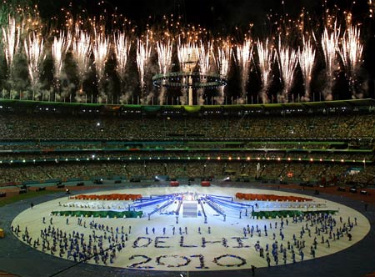
The 1.9 lakh-km-long QBR's journey across 71 countries will culminate on October 3 at the Jawaharlal Nehru Stadium before the opening ceremony of the Commonwealth Games.

The Queen's Baton Relay is a torch race symbolising the unity and shared ideals of the Commonwealth of nations. It carries a message from the head of the Commonwealth of Nations, currently Queen Elizabeth II of the UK.

The baton has the ability to capture images and sound as it travels throughout the nations of the Commonwealth. With Global Positioning System (GPS) technology, it can be tracked through exact location.

Thursday, September 30, 2010

Five-star Hotels Assist in Cleaning CWG Village

Bringing heavy duty equipment and expert staff, top five-star hotel chains, including the Taj Hotels Resorts and Palaces, are helping in the last-minute massive clean-up drive at the Commonwealth Games Village, officials said.

The hotel chains have come in along with their large housekeeping departments to help in cleaning the rooms at the athlete's village for the Games beginning Oct 3. "Heavy duty equipment have been moved in by five-star hotel chains," a diplomatic source said here Tuesday.

"Several flats had 'pan' (betel nut) stains. It was difficult to remove them with normal cleaning detergents," a CWG Organising Committee official said.

With all the teams set to arrive by Friday, officials are keeping their figures crossed and hoping that the village rooms will be ready before Friday. "We hope that with the hotel chains helping out, the rooms will be soon cleaned up," the official added.

The Games Village has faced a lot of criticism over the state of the residential zone - with photos of pan-stained bathrooms, muddy beddings and crumbling flats splashed all over the media.

It led to a massive outcry, after which the CWG Organising Committee along with the Delhi government had to finally scramble to get their act together for the cleaning up process.

The issue became further dire after diplomats of the Commonwealth nations got access to the residential zone over the last weekend.

Commonwealth Games Opening and Closing Ceremonies combined to save everyone the bother

There was immense relief last night when it was confirmed that the 2010 Commonwealth Games in New Delhi will be shortened to simply consist of a spectacular and colourful Opening Ceremony followed immediately by an impressive and moving Closing Ceremony.

Organisers decided to pull the plug on the competitive element of the event within hours of the electricity supply finally being connected, citing concerns that firstly the competitors’ accommodation at the Games Village may not stay standing for more than a few more days, and secondly because there’s only so long you can go before a trained monkey security guard cracks and goes for a recuperating athlete eating a banana.

The event, now being dubbed ‘a 15-minute extravaganza celebrating the modern legacy of the old British Empire’, will see pyrotechnics and massive-scale choreographed dance routines, followed by a presentation of the athletes marching around the potholed running track. There will then be a pause for international broadcasters to describe the electric atmosphere in the stadium and patronise local culture, before Prince Charles, representing the Queen as head of the Commonwealth, will declare the Games open, and then shut.

A spokesman for the BBC in Delhi said that the Corporation was not too disappointed at the decision. ‘A lot of our key presenters were already in a lot of trouble at home at the prospect of their sidling off for another fortnight’s jolly when they’ve barely got over their hangovers from partying it up at the World Cup,’ he noted, ‘But don’t worry, BBC standards will be maintained — we’ve already filmed a few Slumdog Millionaire comparison pieces for Children in Need, and if anything big does happen in the next couple of weeks, like a stadium collapsing, there’ll be plenty of coverage we can pick up from YouTube.’

Despite the British public’s outbreak of indifference to the decision Craig Hunter, chef de mission of the England team, said it was a shame that his athletes’ involvement would only amount to a quick trot around the running track. ‘The event’s been unlucky in being plagued with bureaucratic problems, clashes with other important sporting events, and unexpected fever outbreaks, meaning many of the finest competitors the Commonwealth has to offer decided to stay away. But it’s a shame they couldn’t have stuck with it anyway. I mean with no-one else here, I think there was a fair chance we might have actually won something.’

Dehli struggles to escape Beijing shadow

Stunning venues, near-flawless organisation and a table-topping performance: China dazzled the world with a 2008 Olympics that leaves India's troubled Commonwealth Games in the shade.

New Delhi's Commonwealth Games have been tagged the "Shame Games" by local media after a shambolic run-up to Sunday's opening that has reinforced the nation's reputation for inefficient bureaucracy, poor infrastructure, graft and squalor.

India's travails are a far cry from southern China's Guangzhou, where up to 12,000 athletes from 45 nations are expected to attend the Asian Games in November, two years after the Beijing extravaganza.

In glaring contrast to India, Guangzhou is quietly going about finishing preparations for the Asian Games -- the world's biggest sporting event after the Olympics.

Wu Yucheng, an official at the government's Guangdong Sports Bureau, said he was aware of the problems in Delhi but declined to elaborate.

"We have been planning for the Asian Games for seven years. So we started our preparation early. We have invested a lot of money in the Games and the city infrastructure," he said.

"In Guangzhou, you can look around and you will see that a lot of things are happening. Every day you see new changes in the city.... It is not only about the Games, but it is about the city."

Fifty-eight venues have been refurbished for the Asian Games and 12 more have been built from scratch. Finishing touches are being applied a month in advance, while venue personnel are in place, testing equipment and learning their roles.

Taking pride of place is the huge, gleaming Guangzhou Olympic Centre for track and field, swimming and equestrian events.

Other competitions will be held at a brand new Asian Games Town in a semi-rural part of the city, while the opening ceremony will take place at a newly-built amphitheatre in the Pearl River skyscraper district.

Against this, the multi-sport Commonwealth Games teetered on the brink of collapse last week as some nations threatened to pull out amid worries about security, a bridge collapse and the standard of accommodation and venues.

Problems with the Delhi Games also include an outbreak of mosquito-borne dengue fever and doubts about transport, fire and evacuation procedures and medical services.

All this has dashed the hopes of the country of a billion-plus people of showcasing itself as an emerging power and delivering an event to rival Beijing, analysts say.

Concern about the negative impact was expressed by a leading Indian business lobby group.

"It is a sad state of affairs indeed and, psychologically, puts a question mark against India’s capacity to deliver," said Amit Mitra, general secretary of the Federation of Indian Chambers of Commerce and Industry.

But there are signs that things are coming together at the last minute as hundreds of competitors arrived this week to take up residence in the much-criticised athletes' village. As many as 5,000 athletes from 71 nations and territories formerly linked to the British Empire are expected.

It would also be a mistake to characterise Beijing's experience as flawless and it is too early to say whether there will be any last-minute glitches at the Asian Games.

Beijing enjoyed a huge boost to its infrastructure through developments such as new subway lines, but has struggled to find a role for iconic venues such as the Bird's Nest stadium and the Water Cube aquatics centre.

Wu said both Guangzhou and Beijing had taken a comprehensive view of organisational issues and admitted there had been problems in the run-up to the Asian Games.

The deputy secretary general of the Asian Games' organising committee, Gu Shiyang, underlined planning and local support as key factors.

"Good planning is one factor, but the most important factor is the support from the government and the citizens as well as state-owned enterprises and private enterprises, the support and participation from all walks of life.

"The educational considerations are also very important. We have 50,000 volunteers for the Asian Games. Most of these volunteers are from the colleges and universities. And also we have 500,000 city volunteers."

He said in the coming weeks all venue teams would be doing rehearsals and drills to make sure their venues operated smoothly.

Two more Aussies skip Delhi CWG due to injury

Australia have lost two more athletes from their Commonwealth Games  squad, with reigning discus gold medallist Scott Martin among two track and field competitors forced to pull out due to injury.

The Sydney Morning Herald quoted Australian officials as saying that Martin and hurdler Hayley Butler did not arrive with the rest of the athletics squad in Delhi early on Thursday morning after deciding to withdraw from the competition earlier this week.

Martin, 27, was forced to withdraw after suffering an injury to his pectoral muscle, robbing him of a chance to defend his discus title from Melbourne in 2006, when he also won bronze in shot put.

Meanwhile, 26-year-old Butler stayed in Australia to recover from stress fractures in both feet.

She was to compete in the 100m hurdles alongside Australia's Olympic silver medallist Sally Pearson.

The pair followed fellow Australians Dani Samuels, Travis Meyer and Stephanie Sang in becoming late withdrawals, though the latter trio pulled out earlier this week due to concerns over security and health.


back to top